A Night of Khantoke Dinner and Dance

       Kantoke Palace, Chiang Mai 

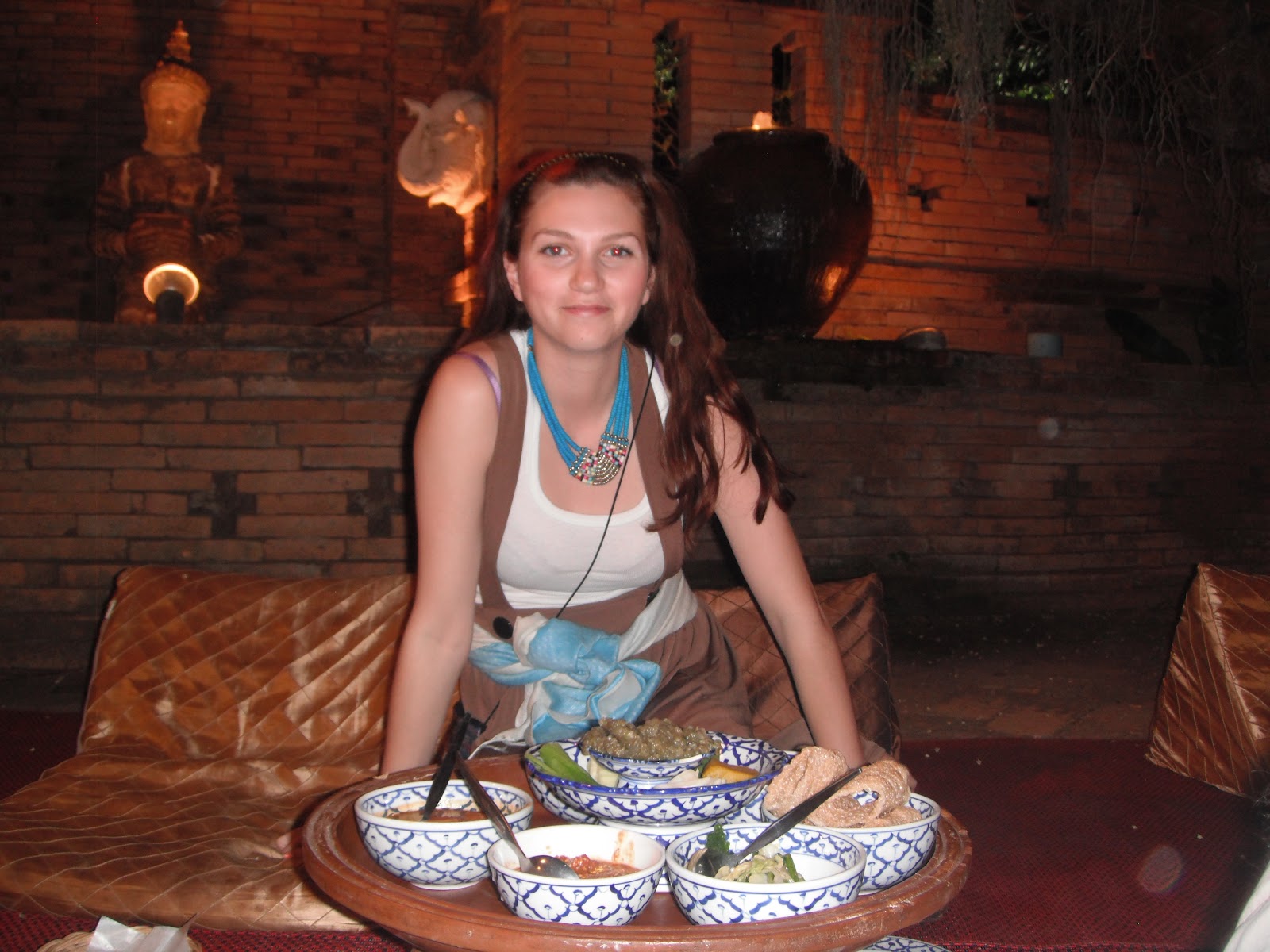
The Lanna people of Northern Thailand, have a particular dining style, (an ancient tradition really) called Khantoke. Khantoke is a dining style, where a round and low pedestal tray made of bamboo, rattan or wood is used to serve the food. It is tradition that the family or parties will sit cross-legged on the floor around the Khantoke tray. Several bowls of Lanna food are served on the tray with sticky rice, the number one staple of the Lanna.

The Lanna love sticky rice SO much, sometimes they joke that they lost the battle because the armies spent a lot of their time preparing and eating sticky rice!) The sticky rice is rolled into balls by each person and dipped into the food of their choice. Eating Khantoke means the food on the pedestal is shared by all and eaten slowly. Its a beautiful tradition!  In todays modern world Khantoke dinners are still very common in the home, at weddings, ordinations, celebrations, funerals and other ceremonies.

While in Chiang Mai we heard about The Kantoke Palace, a gorgeous place where you can learn more about the Lanna through food and dance. We heard that there was a Sword Dance, so we jumped on the opportunity to go. When we arrived, we were pleasantly surprised- there was even more to see than we realized! Upon entering the gates of Kantoke Palace, we were greeted by beautiful young women exhibiting Lanna arts. One woman was carving intricate flowers from melons, another was playing an old Lanna instrument that reminded me of both a harp and xylophone.

  
Be sure to leave your shoes at the door!


The food was absolutely amazing! In the middle is the eggplant and hot chili dip, served with vegetables. Then we have a few curries, some sweet and crispy noodles, some deep-fried pumpkin crisps and deep-fried tofu. Lam mak! ( Very delicious)

                                                            
The dance ceremony was started with Lanna music played live, with the ancient Candle Dance following. Next was the Umbrella Dance among many others, and then finally the Sword Dance, which was traditionally used by the Lanna warrior before entering battle. It was believed to bring power and good luck to the warrior. (The Sword Dance needs a blog of it's own. Check back soon!) 


Thanks for reading!  If you'd like to visit the Kantoke Palace,
or learn more about Lanna tradition and dances, visit: KantokePalace.com

Muay Thai @ The Loi Kroh Stadium

 
Before I came to Thailand a good friend of mine started learning Muay Thai. She had me promise her that I would not leave Thailand without seeing a Thai boxing match! Muay Thai is extremely popular in Chiang Mai particularly, and it is common to see flyers for the upcoming match stapled all over town, in restaurants, and being hand-delivered to people on the streets by men on motorcycles.

 We decided to go to the Muay Thai stadium on Loi Kroh Road (a popular club area) to see two fights between Thais, and the headliner for the night, U.S.A vs. Thailand. As you might probably suspect, Thailand came out on top. Even though I usually dont like watching sports which revolve around violence (I just feel bad for them when they start to bleed!), I thought the matches were really entertaining because it IS a form of art, and an important part of Thai culture. It is not always necessarily about weight, size or strength, but more about technique. There are many years of training to become a professional Kick-boxer and apparently the boxers even get voluntarily beaten with heavy, rock-hard bamboo branches during training, the purpose of which is to kill the nerves in their legs and other body parts to prevent them from feeling pain during a match! Ouch. 


Another Stroll Through Yarowat, Chiang Mai

One of my favourite things to do: Take a stroll through Yarowat! 
(Otherwise known as the China-town of Chiang Mai.) Many Thais have Chinese ancestry, especially in Northern Thailand where Chiang Mai is. This culture of Thai-Chinese is known as Lanna, or Lan Na.

It was the Lanna kingdom that ruled here between the 18th-20th centuries, but there is still so much history to be learned about the rule of Lanna, its people and its traditions which are still being lived out today by some locals.
!Yarowat is always a colorful place to be. It may not be for everyone (much like everything else), but for some, the beauty is easy to see. The sights, sounds, and smells are mesmerizing for the backpacker searching for a cultural mecca; people from every country, speaking every language, an abundance of traditional Thai and Lanna clothing, delicious foods lining every street and every alley, the chaos of cars, motorbikes, tuk-tuks and song taews, the smell of curries, deep-fried pastries, and the mountains of merchandise which can be found retail or wholesale (and of course there is no tax).  This market area operates 365 days a year, and is open from daylight to sundown!    
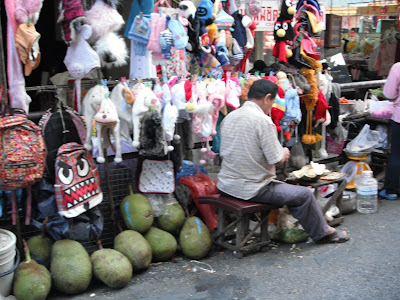
A man cutting up some Jack fruit. (This is not rare to see:  a man selling childrens
 backpacks and hats on the side of the road is also selling Jack fruit!)

Turning off the main road you will find what seems
 like winding tunnels full of vendors of every sort.

For Sale: touques, flowers and potatoes!

The Legend of Thai Silk


The next stop on our escapade was visiting the world-famous Thai Silk Museum and
Boutique,
"Shinawatra", 
 pronouced Shinawat. It is the oldest Thai Silk Factory in all of the Kingdom, is based on Lanna-style (Thai & Chinese mix culture) craftsmanship and is 100% Thai-owned. Since 1911, the Shinawatra family has been producing quality silks in Thailand and has grown from supplying Bangkok and Chiang Mai markets, to running one of the most renowned Silk boutiques- here in    the Chiang Mai District of Northern Thailand.

It is now a large attraction where people from around the world come to learn about how silk is made, from the silk worm, to the loom, to the shelf. This includes Thais, foreign tourists, Thai Government Officials, and even Royalty, including in the past; Princess Diana of Wales, the Prince of Luxembourg, the Queen of Malaysia, the Queen of Denmark, the Prince of Japan etc.


 When you initially enter the museum you are immediately greeted by beautiful Thai women, who lead you under a stunning Lanna-style pagoda (right), surrounded by beautiful gardens where you are served your choice of cold-teas.

They then take you through the museum, explaining each process of production, which starts with the Silk Worm, who I think needs more credit in all of this!

Silk is naturally produced by the Silk worm, which feeds on the Marlboro leaf (top left). Silk producers have bred and farmed many varieties of Silk Worms for thousands of years (domesticating them, they no longer are known in their natural state) They are fed a buffet of Marlboro leaves to initiate the process. As the Silk Worm is supplied with ample food, its body moults 5 times before becoming a full-grown caterpillar. This process takes approximately 23 days.

Then, this full grown caterpillar feeds for another 8 days before spinning a silk cocoon to pupate inside for 8-10 days. This silk cocoon is the valuable material, which will later be extracted and processed. Thai Silk Worms, produce yellow cocoons made of yellow raw-silk and Indian Silk Worms, produce white cocoons made of white raw-silk, which is more valuable in the market(top right). After the pupae-period a Silk-Moth will emerge, however most producers allow only emergence of enough moths to "ensure the continuation of the species. Most of the Silk Worms are killed by heat, either by immersion in boiling water or by drying in ovens" 
A worker boiling white Silk-cocoons in the old-fashioned Lanna style.
The length extracted depends on the Silk Worm variety,
 but can be thousands of meters per one cocoon!

Several types of RAW silk

And this is how pashminas, and other
Silk cloths are made! One strand at a time.


The Final Products!


To learn more
about Shinawatra Products/History/Location, or the production of silk please visit the sources listed below. Thanks for reading!
Sources
1) Shinawatra Thai Silk. http://www.shinawatrathaisilk.co.th/, and museum references

"No Dress-Rehearsal, This Is Our Life.."

Sankampaeng Hot Springs


We also made a stop at the Sankampaeng Hot Springs.
The drive was beautiful, passing mountains and rice paddies the entire way.


Although we found out Sankampaeng is rather touristy (not for foreigners, but for Thais themselves, we were one of the few falangs there) we still enjoyed our time there. There are several paths winding through a beautiful botannical garden-where believe it or not, people can actually camp overnight Following the path to the Hot Springs, the park pays homage to giant mushrooms- The Asian love their mushrooms :P


Being around Chiang Mai means lots of beautiful mountains and flowers.  


 Eggs in baskets for sale!
Cook em in the hot springs, and add to the sulphur smell--mm yummy.. lol
No thanks, I think Ill head for a swim in the mineral pool!!


Bo Sang Umbrella Village, Chiang Mai Province


One day we went for a day tour outside of Chiang Mai, with a private Song taew! We left around 8 am, and came back to Chiang Mai around 4 pm, and in total the chauffeuring cost us 400 Baht each! Thats only 12 dollars Canadian for the entire day, making 4 tourist stops, incredible value. We visited Bo Sang, a Hot Spring/Botannical Garden/Mineral Pool, a local Silver and Stone Plant, a Thai-silk Museum and Factory..plus we stopped to have lunch! 

It was a very busy day, but we learned so much 8 hours, we returned to the city with absolutely no energy left. I will be sure to post pictures of all the stops, but first things first, Bo Sang!

We went headed North to visit to infamous Bo Sang Umbrella Village, known for their umbrella festival and umbrella paintings, among other handicrafts, a key highlight of the Chiang Mai province! I previously bought a large canvas bag in Chiang Mai, so at the village I had one of the guys, Pasin, hand-paint these two love birds on it,<3--painted and dried, all in about one minute! It's really amazing what art some of these ladies and gents do. Check out this wall-size fan below! Sawai (beautiful)

"The way is not in the sky. The way is in the heart."

"Do not believe in anything
simply because you have heard it. 
Do not believe in anything
simply because it is spoken and rumored by many. 
Do not believe in anything
simply because it is found written in your religious books.
Do not believe in anything
merely on the authority of your teachers and elders. 
Do not believe in traditions
because they have been handed down for many generations. 


But after observation and analysis, when you find that
anything agrees with reason and is conducive to the
good and benefit of one and all, then accept it and live up to it." 
 - Gotama Buddha


"Buddha" is not the name of a person, or God. It is a word used as a reference to any "enlightened" person. We can all become enlightened, therefore anyone can become a Buddha with awareness, equanimity, compassion and understanding.
However Buddha did say that only you can walk your own  path to enlightenment, and that it is very hard work. He taught that he could only show the way- What more could we really expect?

Many people have misunderstood Gotama's teachings and have followed in blind belief, hoping this could save their fortune. Turning the texts into a religion, they have twisted his words, that were meant to help all, not just a particular religion, or race, or caste. 

 When you understand properly, you see that Buddha was clearly and strictly non-sectarian, and wanted to share his light with all people, universally, regardless of religion or any other dividing factor. He did not want to be worshipped, he did not ask for this. He did not claim to be God. He only asked that we observe ourselves, our thoughts, the law of nature, that we begin to live free of aversion and craving, so that we can all live in happiness, and peace, free from all suffering & misery.